
The Real Thing
My father was always himself—especially after his excommunication

When my mother interviewed for the teaching position at a Catholic primary school in Tennessee, she wasn’t certain whether she had been excommunicated nine years earlier when she married my father. There had been no public flogging, no being paraded through the streets to be spat upon. She didn’t even get a letter.
At least my father got a letter. Here’s what Bishop Vath wrote to him:
Dear Mr. Tuohy,
You were a priest of the Diocese of Mobile-Birmingham and later of the Diocese of Birmingham in Alabama from your Ordination in 1961 until you attempted marriage with your present spouse. As a consequence of this action on your part, your excommunication from the Church was automatic. As you must know, your actions at the time caused great scandal to large numbers of the Catholic community and your refusal to apply for laicization leaves you in the perilous position where you may not even receive the Sacraments according to present Church discipline…
Dad could have avoided this unpleasantness by applying for laicization—giving up his priesthood—before (successfully) marrying my mother, the former Sister Margherita. He refused because he knew from the age of six—when the Virgin Mary healed him of his tuberculosis—that God had called him to be a priest. After years working under a segregationist archbishop and a conference of American bishops too cowardly to oppose the Vietnam War, Dad figured no man in purple vestments was qualified to dispute his calling.
But the Episcopal bishop of Alabama believed Dad had that calling. The two men got to know each other while feeding the poor in Huntsville when Dad was the director of Interfaith Mission Service.
“Jim, why don’t you come over and join with us?” Bishop Stough said one day in his refined drawl.
After miraculously clearing this conversion with my—shall we say—more-than-reluctant Irish nationalist mother, Dad moved the family to Sewanee, Tennessee, where he would spend one year studying Anglican traditions at the Episcopal seminary. The higher-ups there gave him credit for the six years he had already studied at a Catholic seminary in Ireland.
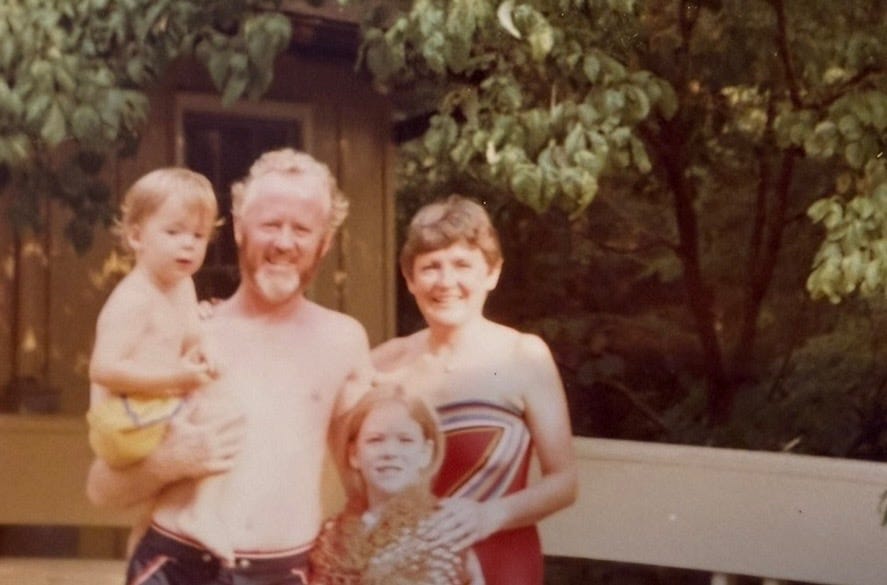
This was 1979. My sister was seven, I was one, and our family was very poor, which is why Mom went down the mountain to the Catholic school in Decherd to apply for the open sixth-grade teaching position.
The principal was a lovely Dominican named Sister Eileen who was very impressed with Mom’s resume—eight years teaching at Saint James Catholic School in Gadsden, Alabama, two of those years also serving as principal, then another two years teaching in Huntsville public schools.
The earnest Sister Eileen conceded she was eager to hire Mom on the spot, but she’d have to clear it with the pastor, a rather strict German. A few days later, Eileen called and invited my mother back down to the school and offered her the job on a condition insisted upon by the pastor—that neither she nor my father attend Mass expecting to receive communion.
“You’ve no need to worry about that,” my mother said.
“Oh, Elma,” Sister Eileen then whispered with total sincerity. “Won’t Jim’s Episcopal parishioners be so fortunate? When he says Mass for them, they’ll be getting the real thing.”
The good stuff
Dad got a kick out of teasing his Episcopal colleagues with that story—the implication being they were all a bunch of frauds when it came to turning bread and wine into the body and blood of Christ. Only a Roman Catholic priest could do that—excommunicated or not, apparently.
Dad never put much weight on what he saw as ridiculous man-made rules. What mattered for him was how you treated the poor, the sick, the prisoner, the foreigner, the oppressed.
Bishop Stough knew that about Dad, which was why he made him the associate priest at an urban parish called Saint Andrew’s in Birmingham. There, Dad and his new boss, Rev. Maurice Branscomb, established a soup kitchen to feed the scores of local men, women, and children newly homeless or hungry on account of Ronald Reagan’s drastic budget cuts.
At noonday services, they’d have university professors and lawyers sharing pews with folks right off the streets. One day early on, a skinny fellow with wild hair and a scraggly beard kneeling at the rail took the chalice from my father’s hand, turned it up, and gulped down a big slug. Smacking his lips in satisfaction, he smiled and said, “That right there is the good stuff, Rev!”
Dad couldn’t wait to get to the sacristy to tell Father Branscomb.
“Maurice,” he said, with feigned solemnity. “I want you and the ladies of the altar guild to know that I have it on the highest authority this wine you’re procuring for communion is of the most exquisite quality.”
Grounded
As a Catholic priest, Dad lamented how some of the finest, most faithful Catholics he knew had been divorced, that it pained him to see them prohibited from taking communion. Now he was able to give the sacrament to anyone who showed up—divorcees, the homeless, gay men dying of AIDS, whomever.
He was the real deal—always himself and never putting on airs. Every morning, without fail, he spent 30 minutes meditating alone with his Bible. This centered him to do the hard work of feeding the poor, counseling the sick, and calling out the government of the richest country in the history of the world for not helping.
“If Chrysler and Lockheed need federal assistance,” he told the Birmingham News in October 1982, “then certainly the elderly and the handicapped need federal, state and local assistance. We do emergency assistance and our case load has doubled this fall.”
I wrote a few weeks ago how his activism against the Reagan administration’s attempts to overthrow foreign governments landed Dad on an FBI watch list. He worried, of course, but did not let that hinder his determination to advocate for what he believed was just.
Please don’t embarrass me!
Dad was never not himself. Except on the rare occasions he’d take my sister and me to McDonalds, during which time he’d put on a terrible southern accent.
“I want me a Big May-uc and a saaad of frahs,” he’d say at the drive-thru window. “And git me two happy mee-uls for muh kee-uds.”
“Stop it Daaaaad!” we’d scream, from the back seat, red-faced with embarrassment.
But our objections only made him laugh.
“Ah, come on now kids,” he’d say. “They won’t understand me Irish accent!”
Growing up in Alabama with outspoken liberal parents with funny accents and weird jobs wasn’t easy for a closeted kid like me who just wanted so desperately to fit in.
When I was 13, I entered eighth grade at a prep school where my mother taught literature and poetry. It was hard enough being a teacher’s kid. On a daily basis, I got thrown into trash cans or into the campus lake or both. But then the administration invited Dad to play his accordion for the whole school on Saint Patrick’s Day.
I begged him not to come.
“Please, please, please, I will die!!!”
“Ah grow up, Fergus!” my mother said. “Don’t be embarrassed by your parents. You’ll miss us one day when we’re not around.”
When March 17 arrived, I was a nervous wreck. The school set Dad up in a large atrium in the library. As the whole student body and faculty took their seats, I hid in the stacks, sweating, pacing nervously, talking to myself about how my life was ruined.
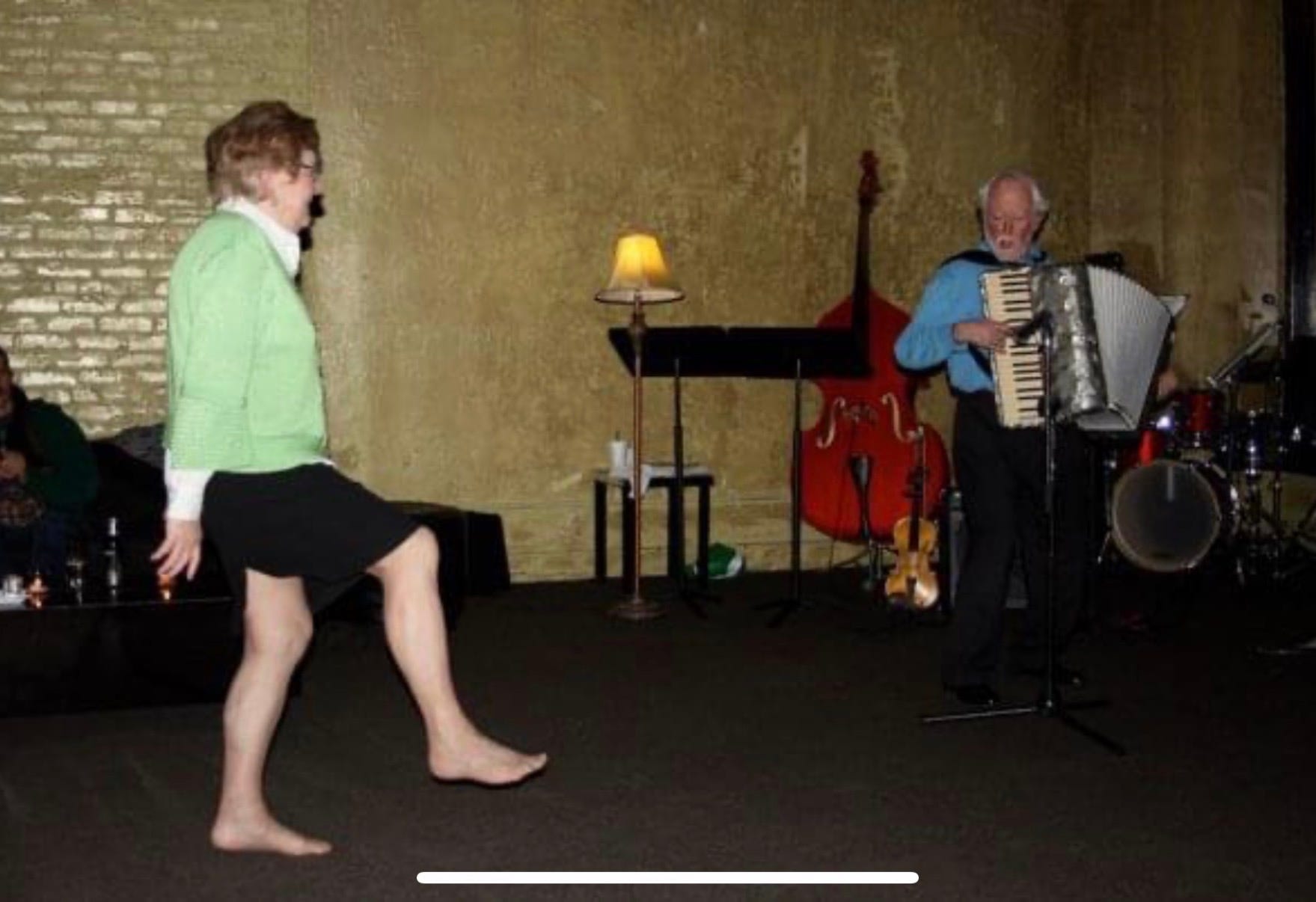
Then I heard the accordion bellows and the music began. The next thing I knew he was calling my mother up to dance a jig.
“Oh, Jesus, no!” I said to myself as she hopped up, kicked off her heels, and started throwing her feet into the air. The place went wild. Everyone was hooting and hollering. Then Dad brought the whole crowd in, teaching them the chorus for the next tune and cheering them on as all sang together.
“It’s no, nay, never…bum, bum, bum, bum! No nay never no more! Will I play the wild rover, no, never no more!”
When the thunderous applause died down, I slinked out from the stacks and tried to make it to my next class unnoticed. Upperclassmen surrounded me—the girls all gushing about how cute and cool my father was, while the same boys who tormented me daily for their sport gave me high fives.
Honeymoon with the parents
Ah, well, I suppose it’s natural for teenagers to be embarrassed by their parents. This aversion softened in me in the years that followed, especially as I grew wise enough to understand how mine loved my sister and me unconditionally. At the age of 31, at Sunday dinner, I finally got the courage to come out as gay, and they embraced me wholeheartedly.
“Well, it’s no secret that David and Johnathan were in a same-sex relationship. That’s King David!” Dad said, pounding the table with his knife and fork.
He went on to list several admirable gays from history, literature, and Irish mythology, eventually ending his sermon by saying he loved me and was proud of me.
“This is a cause for celebration!” he declared, raising his glass of wine.
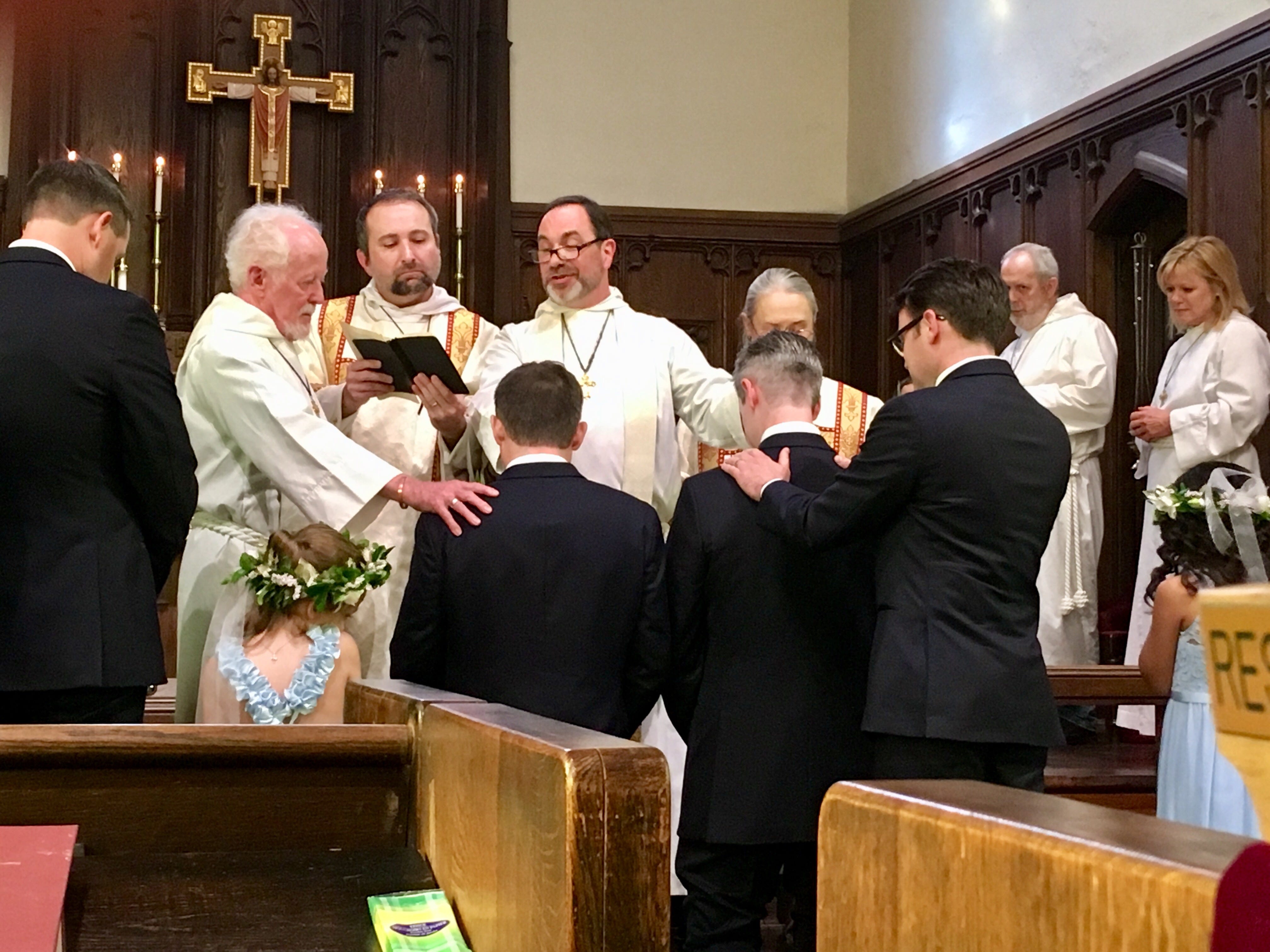
Some years later, when Dad was 81, he stood by the altar at Saint Andrew’s and blessed my marriage to Michael.
Our honeymoon would be Michael’s first time in Ireland, and it would be my parents’ last. That’s right, my new husband and I took my parents with us. You see, they went back to Ireland every summer to visit friends and family. For a long time, Mom brought groups of students to show off all the holy and literary sites, with Dad driving the bus, leading the awe-struck American teenagers in song. By the summer of our wedding in 2018, Dad’s dementia was quite advanced. We knew this would be their last opportunity, and it was Michael who suggested we bring them along.
I wasn’t embarrassed by them anymore. Not even on the first night when Dad got lost on his way back from the bathroom and wandered into our room in his t-shirt and underwear asking, “Where am I? Where am I?”
Ah, sure it was a great trip altogether. Michael got to experience Ireland with two of the country’s most passionate ambassadors. It could be stressful at times, like when Dad kept asking, “Elma where are we?” But he settled in after a few days, and we had a magnificent time together.
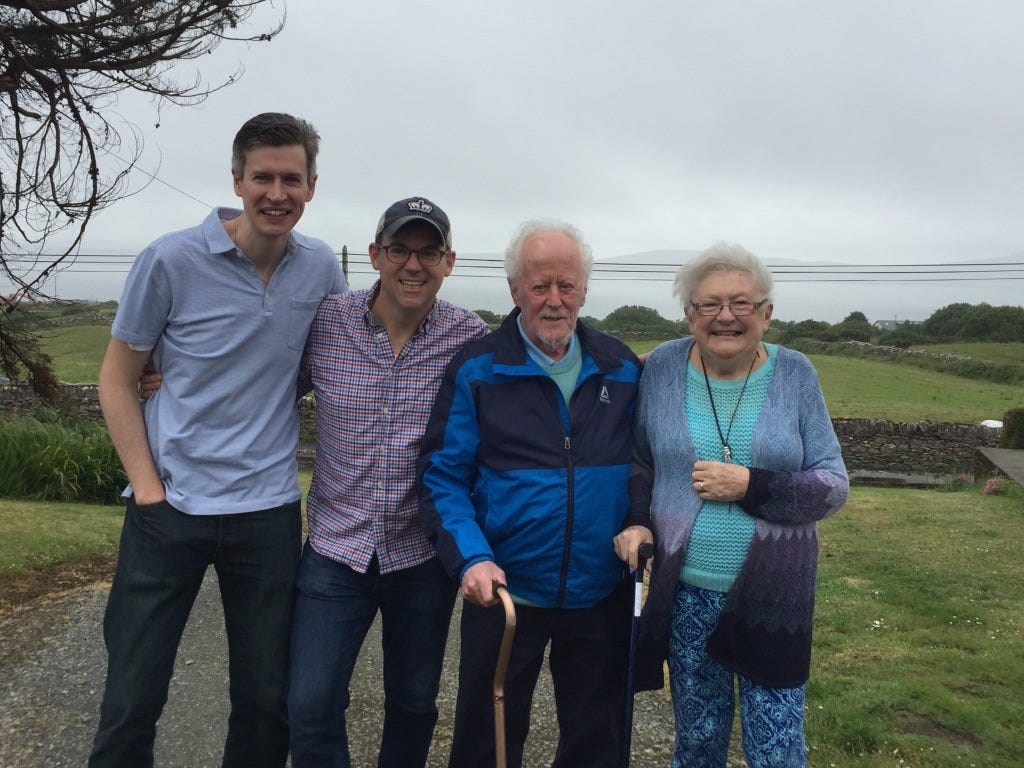
On the way home, as soon as we walked inside Dublin Airport—Michael and me on either side of my parents, hobbling along with their canes—smiling Delta agents bent over backwards to help, ushering us onto a golf cart and moving us to the front of every line from the check in, to security, to customs, to the gate.
“We need to travel with you two more often,” I said.
There was only one more thing I needed to worry about—the nine-hour plane ride home. On the way over, the four of us took up the four seats in the center of the plane—Michael and I flanking Mom and Dad in the middle, where we could keep an eye on Dad. Sometimes he forgot where he was and called out to flight attendants as if they were nurses or waitresses.
“Chardonnay!” he called out several times. “Chardonnay!”
But going back to the States, we were split up by the aisle. Michael was beside the window, then me, then the aisle, then Mom then Dad, then two women we did not know.
“I’ll make sure he behaves,” Mom assured me as we got seated.
On the other side of Dad was an attractive lady in her late forties with a nice tan and big hair. She thought Dad was the most adorable thing she’d ever seen. She flirted with him and he flirted right back. She told him she was from Kentucky and had a great time riding horses all over Ireland. He told her his brother lived on a horse farm in Virginia.
“You see, my brother Liam married a rich widow,” he said, “and I married a poor virgin.”
She howled. “Oh, you are so precious!”
“Don’t mind him!” said my mom, rolling her eyes.
After taking off, the kind lady helped Dad turn on his television and browse the movies.
“Ok,” I said to Michael, exhaling a deep breath. “I think we’re going to be ok.”
I leaned back in my chair and opened my book, and then I heard the lady say to Dad:
“So, what do you think of Donald Trump?”
Everything slowed to a near stop. My eyes like saucers, in slow motion, I began turning in my seat trying to interrupt, shouting, “Nooooooooooooo!”
I never had a chance. At once, everything returned to normal speed and Dad answered her flatly:
“Jaysus, I think he’s fuckin’ awful!”
Leo the Real
These days, I often think maybe it’s better neither of my parents is around to see what’s happening in this country. They fought the good fight for many years. To see the old hatreds and injustices reawaken with such grotesque force would be a lot to bear.
Still, they left a loving legacy. Dad was the real thing—in the big moments and in the mundane, whether taking on the archbishop or teaching Irish songs to high schoolers. It’s taken me a long time, but I try now to be authentic like he was—never shrinking never conforming.
In any case, I do believe he and Mom would be proud of the new pope. Like Dad, Pope Leo XIV is grounded in the gospels and is not afraid to speak truth to power.
“I have no fear of the Trump administration nor speaking out about the message of the gospel,” the pope said this week. “I will not shy away from announcing the message of the gospel, of inviting all people to look for ways of building bridges for peace and reconciliation, of looking for ways to avoid war any time that’s possible.”
I am certain Dad would have cheered for Leo. I am certain Dad would be over the moon knowing his Catholic brothers and sisters are getting the real thing.
Each week, as I write this family memoir, I will publish a new reflection inspired by my parents’ example of living authentically and courageously no matter the personal costs.
Their ultimate redemption—finding great joy and purpose in life—will uplift anyone despairing over the current state of world affairs.
Their story is for all of us.
If you’d like to follow along, you can become a free or paid subscriber below.
They were such a blessing to all that knew them, including me, Greg, and our sons. What an amazing team they made! Love all the Tuohys so very much!❤️
Your father's authenticity and accordion drew me back into the church after a long hiatus. I adored both of your parents.