
Speak Up—Not Everyone Can
Before and after the convent, my Irish mother did not hold back

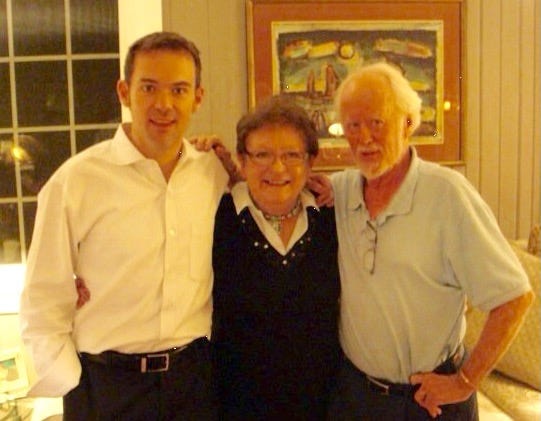
My mother could not keep her mouth shut.
This was not a flaw. It was a virtue.
Last week, I shared how she was exceedingly opinionated and stubborn.
This week, I will tell you—she was also hilarious.
One Sunday, not quite twenty years ago, I was enjoying a roast chicken dinner with her and my father on their screened front porch. They loved that porch. It was like a little tree house nestled in a thicket of greenery surrounding their cozy bungalow across the street from a public golf course. My parents ate all their meals out there when the weather was warm enough.
This was a lovely spring evening. Mourning doves cooed from the treetops. Wrens flitted about in the branches beyond the screen. Squirrels chittered. Along the sidewalk below the lawn, joggers trotted by and mothers pushed prams. We could hear the soft clinks of club to ball as the last players finished their rounds across the road.
“Oh Fergus!” my mother said, suddenly remembering something. “I had that contractor come by this week. Ya know—the oul’ fellow who built this porch for us.”
Vaguely, I recalled a stern, gray-haired man who kept a pouch for his glasses clipped inside his shirt pocket.
“Oh yeah?” I said. “For what?”
“I want all our windows replaced. But let me tell you what happened—we got into an awful fight.”
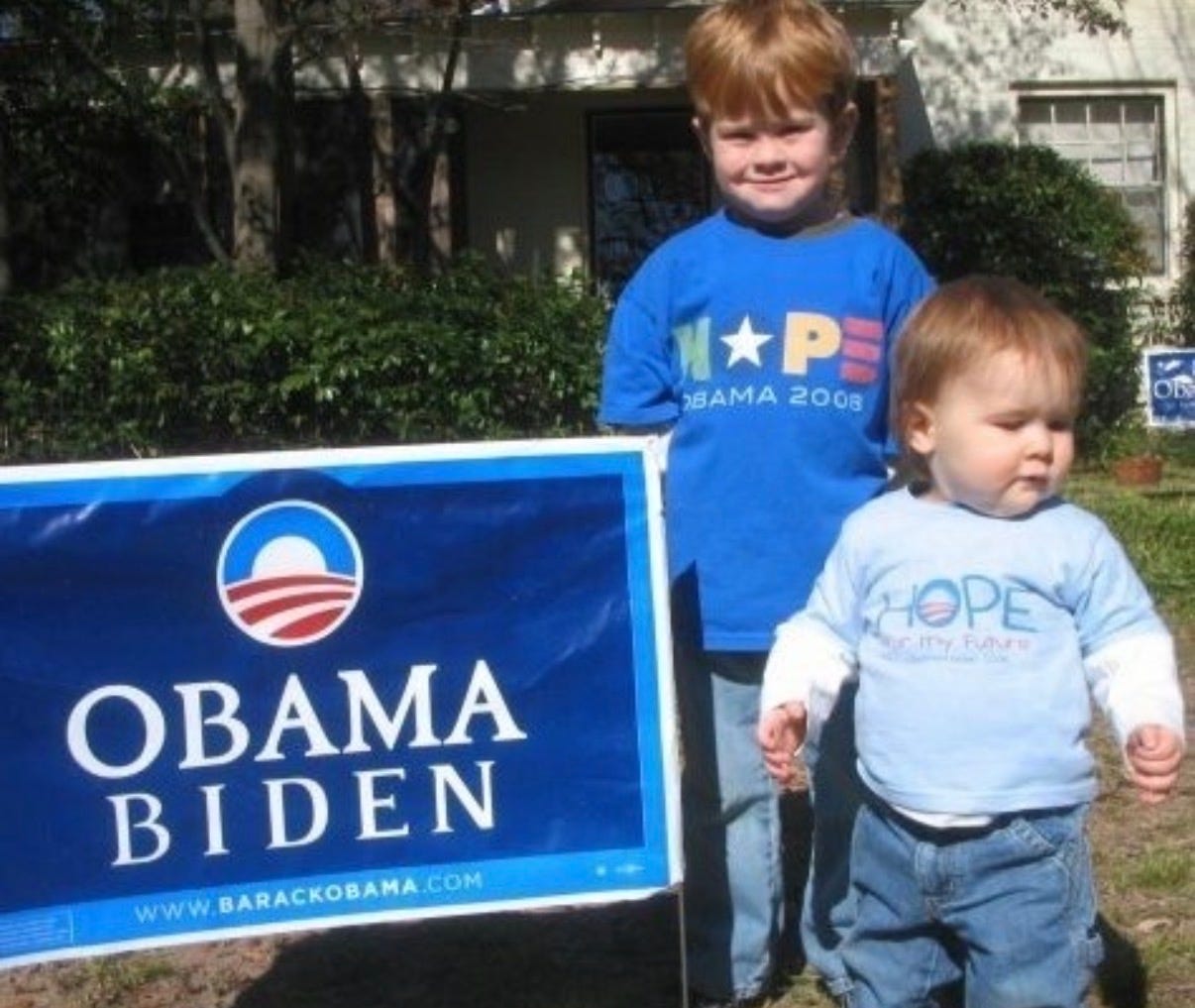
Mom said that as soon as she greeted him at the door, he laid into her over the Obama sign in her front yard.
“Don’t you know he’s a Muslim?” the man barked.
“No he’s not!” my mother snapped back. “And so what if he was?”
“Good for you, Elma,” said my father, saluting her with a fork full of dark meat.
“Ya wouldn’t believe it!” she continued. “He was tellin’ me this awful stuff about original sin. And I said to him, ‘How can you claim that a precious, innocent baby is born sinful?”
Mom had recently welcomed her second grandchild into the world, so she was taking the man’s scornful pronouncement a bit personally.
“And what did he say to that, Mom?”
“You wouldn’t believe what he said! He tried sayin’ to me that all babies are born liars, that they cry when nothing’s wrong just to satisfy their gluttony.”
“That’s pretty dark,” I said. “And how did you respond?”
“I said, ‘Don’t try tellin’ me about original sin. I’m Irish Catholic. My religion invented the concept. And my people perfected the art of spendin’ an entire life feeling guilty over it.”
Dad and I both guffawed.
“That’s good, Mom,” I said, nearly choking on a piece of potato. “So what happened? Did you throw him out?”
“No,” she said, waving a hand in dismissal. “I hired him. He did such a fine job with this porch.”
Vow of Obedience
If you read my essay from last week, you might remember my mother was not one to hold back on voicing her opinions.
There was a time, though, when she had to keep lots of things to herself. That time began when she made her profession as a Sister of Mercy in Dublin and took the vows of poverty, chastity, and obedience.
She faced her first test when her mother died and she asked permission to leave the convent to help her father raise her youngest brothers. The priest, in his ultimate wisdom and authority, put an end to that idea.
“If God wanted you to leave the convent,” said the man, “he never would have allowed you to be professed.”
So my mother, then called Sister Margherita, volunteered to serve in a new mission in Gadsden, Alabama, with the understanding she would be teaching Black children. When she arrived in September 1960, she discovered—to her horror—that every student in the school was white.
“You’re not to say another word about it!” her superior rebuked her when my mother questioned segregation in the diocese. “Don’t rock the boat!”
Three years later, when my mother fell in love with my father, the new associate pastor at Saint James Catholic Church, she did not share with him her forbidden feelings for fear of ruining both their lives. Four long years passed before she mustered the courage to tell him she’d been in love with him ever since he sang O Holy Night from the chancel steps at Midnight Mass.
Over much of those four years, across the ocean, thousands of bishops and other clergy gathered regularly in Saint Peter’s Basilica to conduct the business of the Second Vatican Council (Vatican II), one of the most sweeping efforts to renew the Catholic Church in modern history. Convened by Pope John XXIII, the council aimed to bring the Church into more active dialogue with a rapidly changing world. The twentieth century had already endured two world wars and multiple genocides—catastrophes that, for many, exposed the Church’s confounding silence in times of moral crisis.
The reforms of Vatican II encouraged priests, nuns, and lay Catholics to engage more directly with the modern world, including the wave of social justice movements emerging at the time. For many young Catholics, these changes were deeply energizing, opening up forms of public engagement that had previously felt impossible.
At the epicenter of the growing Civil Rights Movement, my mother was galvanized. She became a kind of local evangelist for Vatican II, carrying a dog-eared red paperback of the Council’s reforms wherever she went and talking about them with anyone who’d listen, including the young nuns newly arrived from Ireland to help staff the school.
But the traditionalist pastor, an older Irishman named Father Bill Jones, cautioned the new sisters about my mother’s naiveté.
“Don’t listen to Sister Margherita,” he said, practically spitting out his words in disdain. “She’s all wet.”
Come to think of it—that fundamentalist contractor, as I remember him, looked a bit like Father Jones.
So when the contractor challenged my mother over Obama and original sin, the former Sister Margherita let loose her wrath. She was not going to let anyone—and especially not any man—tell her what to think.
Before the man returned to work on the windows, Mom added a second Obama sign to her front lawn.
An alien by choice
Mom was really fired up for Obama.
After eight years of George W. Bush—”that eejit,” she called him—with his ill-conceived Iraq War and endless gaffes, she wanted change almost as badly as anyone. I say almost, because there was one thing my mother was not willing to do to effect this change—she was not willing to become a U.S. citizen.
“I don’t agree with American foreign policy!” I heard her say a million times.
When she arrived in Alabama in 1960, she saw terrible things. She saw firsthand the state-sponsored dehumanization of Black citizens. She saw young men from the parish going off to fight and die in Vietnam. And for what?
“How would you feel if someone dropped napalm on your house and killed your family?” she said one time to her class.
An outraged mother called and threatened to report her to the state. She was worried, of course, but she didn’t back down.
By the time they married, my father had already earned his citizenship, but Mom remained fiercely opposed. If Ireland hadn’t blacklisted him for marrying her, I imagine we would have been enjoying our Sunday dinners on a porch somewhere in County Cork.
With the 2008 election, my sister, father, and I tried to convince her this was the perfect time to get her citizenship, but she waived us off.
“Leave me alone,” she said. “I’ll join a phone bank every week.”
And she did. Her brogue unchanged after nearly 50 years in Alabama, the little firecracker called into living rooms across the state asking voters to elect America’s first Black president.
They’re all bloody Republicans in this place
Some years later, after Dad received a diagnosis of mild cognitive impairment, my parents moved into an independent living apartment at a local Episcopal retirement home.
“Fergus,” Mom said one day, early on, when I visited. “I don’t know how I’m going to live here. They’re all bloody Republicans in this place. Except for Eugenia. She’s lovely. I give her my New York Times every afternoon when I’m finished reading it. Which reminds me—would you order a subscription for Eugenia so we can discuss the news at coffee hour? I’ll give you my credit card.”
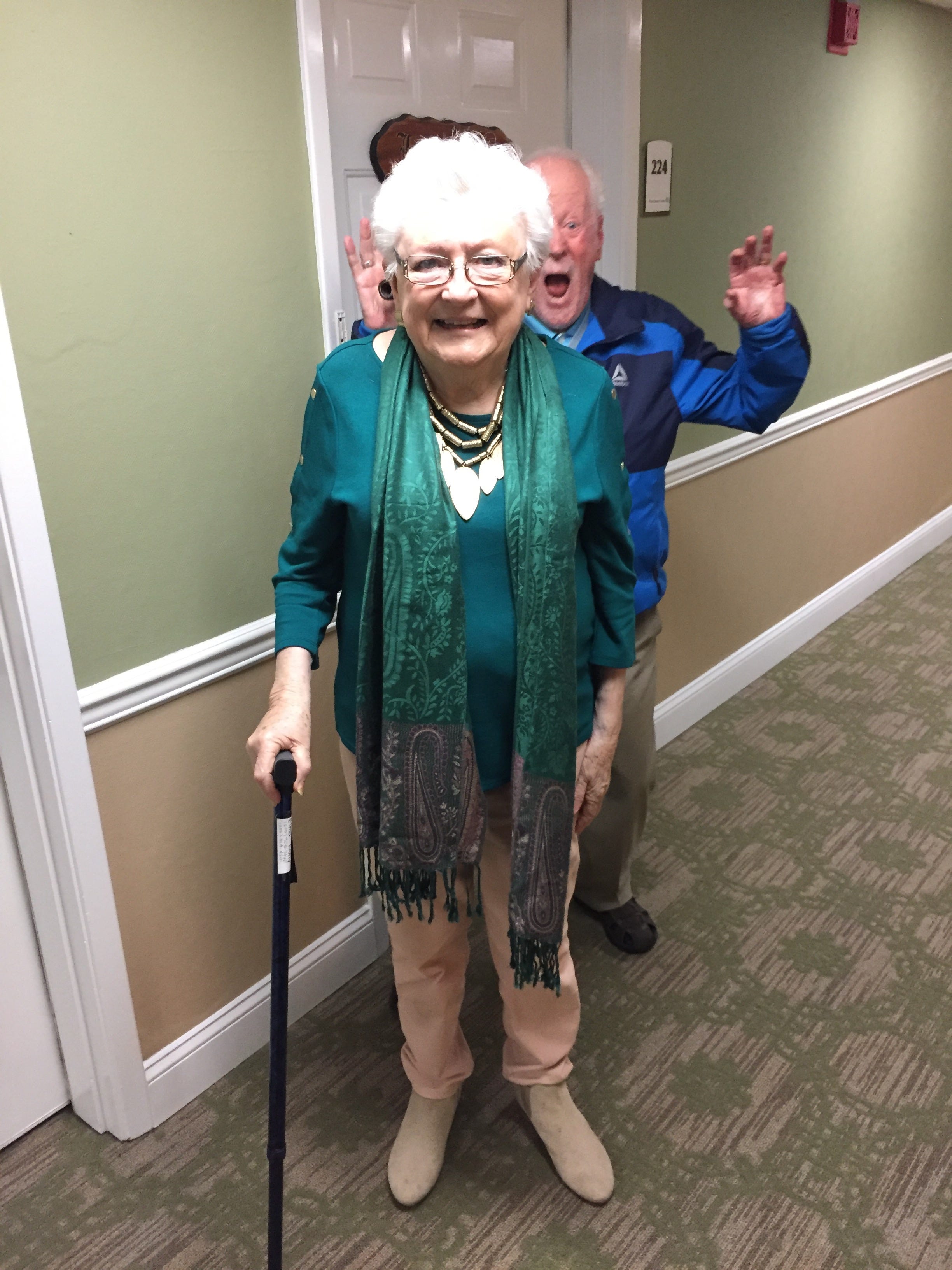
My parents went to that coffee hour every afternoon at 4 pm, always bringing a plate of cookies to share. They made friends with everyone, including all the bloody Republicans, and though Mom seldom brought up politics, if the subject ever arose, she did not hold back. She couldn’t.
For those who can’t speak up
I used to share my mother’s fervor for debating politics with friends and others. But that practice ended for me after January 6, 2021. It ended when the outgoing president lied to the nation, claiming the 2020 election had been stolen. It ended when he incited a violent insurrection against the Capitol that led to multiple deaths and injuries to law enforcement officers.
I mean, how can I possibly have a rational conversation with someone who knows what happened on that day, yet still cast a vote in 2024 for the man who instigated it all?
If those facts haven’t changed their minds, I certainly don’t have the rhetorical skills to do so.
Still, I write.
I write not so much to change minds, but to let others know they are not alone.
After the 2024 election, several people reached out to thank me for voicing my views on the corruption and cruelty being perpetrated by the regime. These people are afraid to speak out themselves. Some fear losing their jobs. Some fear alienation from family or friends or church groups. Some fear retaliation by the state.
I write so they will know they are not alone in their views.
I write because I cannot not write. Like my mother, I can’t be quiet. Who knows whether she altered that contractor’s views, or those of the bloody Republicans at coffee hour? What I do know is that after she died, many of her former students wrote to tell me she had changed their lives—through her passion for literature and her insistence on being fully, unapologetically herself. In these ways, my mother changed many worlds.
So I write about her now. And in so doing, I remember something James Baldwin wrote.
He said: “You write in order to change the world, knowing perfectly well that you probably can’t, but also knowing that literature is indispensable to the world. The world changes according to the way people see it, and if you alter, even by a millimeter, the way people look at reality, then you can change it…”
Each week, as I write this family memoir, I will publish a new reflection inspired by my parents’ example of living authentically and courageously no matter the personal costs.
Their ultimate redemption—finding great joy and purpose in life—will uplift anyone despairing over the current state of world affairs.
Their story is for all of us.
If you’d like to follow along, you can become a free or paid subscriber below.
Fergus, these poignant remembrances of your remarkable parents bring their light back into our world during these dark times, thereby raising our heavy hearts. Thank you.
I am falling more in love with your parents with each beautiful piece. It is also helping to lighten the burden I feel carrying my heavy heart in today's world.